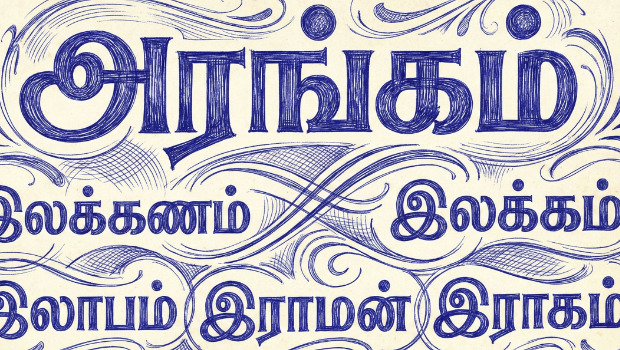
Why Tamil Adds a Vowel at the Beginning of Some Words
Definition
Uyir Mun-sērkkai (Tamil: உயிர் முன்சேர்க்கை) is a phonological process in Tamil, known linguistically as Prothesis. It involves inserting a vowel—most commonly இ (i), but occasionally உ (u) or அ (a)—at the beginning of a word.
This process is primarily used to assimilate loanwords (mainly from Sanskrit) into the strict phonological structure of Classical Tamil. By reshaping incoming words to fit its sound system, Tamil preserves clarity, rhythm, and phonetic balance—contributing to its long-term structural stability.
Phonological Basis
The rules of Classical Tamil (codified in the Tolkappiyam) dictate that native words cannot begin with liquids or trills like ல (la) and ர (ra).
- Phonotactic Constraints: Tamil favors Vowel-initial or Consonant-Vowel (CV) onsets where the consonant is a stop (like Ka, Pa) or a nasal (like Ma, Na).
- Euphony: The liquids L and R are considered "heavy" or unstable to start a word with. To fix this, Tamil inserts a short vowel to facilitate a smoother articulatory transition.
Understanding the "Banned" Sounds: Liquids
Why did Classical Tamil ban these sounds at the start? In linguistics, "Liquids" are the L and R sounds. They are unique because they are not "hard" (like K or P), nor "hissy" (like S). Instead, the air flows through the mouth fluidly, almost like water.
- Too much like vowels: Liquids are very "sonorous" (loud and open). Structurally, it is weak to start a word with a sound so similar to the vowel that follows it.
- Articulatory effort: Producing a "Liquid" instantly from silence requires a complex tongue posture. It is physically easier to start with a Vowel (open mouth) or a Hard Consonant (closed mouth popping open).
The helper vowel (like i- in Ilatcham) acts as a "ramp," allowing the vocal cords to vibrate before the tongue attempts the complex L or R sound.
Types of Liquids in Tamil
Lateral Liquids ("L" Sounds): The air flows around the sides of the tongue.
- ல (la): Dental/Alveolar lateral.
- ள (La): Retroflex lateral (tongue curls back).
- ழ (zha): Retroflex approximant.
Rhotic Liquids ("R" Sounds): The tongue taps or trills.
- ர (ra): The tap/flap sound.
- ற (Ra): The trill or hard R.
Source of Affected Words
Uyir Mun-sērkkai is almost exclusively applied to loanwords (Sanskrit, Prakrit, and later colonial languages) to make them sound "Tamil."
1. Sanskrit and Prakrit Loanwords
Words related to religion, philosophy, and arts often enter Tamil from Sanskrit. Since Sanskrit allows initial L and R, Tamil adapts them.
| Source (Sanskrit) | Common Tamil (Colloquial) | Literary Tamil (Uyir Mun-sērkkai) |
|---|---|---|
| Lakṣa | லட்சம் (Latcham) | இலட்சம் (Ilatcham) |
| Rājan | ராஜா (Raaja) | இராசா (Iraasa) |
| Rāma | ராமன் (Raaman) | இராமன் (Iraaman) |
| Rāga | ராகம் (Raagam) | இராகம் (Iraagam) |
| Loka | லோகம் (Logam) | உலகம் (Ulagam)* |
| Ranga | ரங்கம் (Rangam) | அரங்கம் (Arangam)* |
> Note: While 'i-' is the standard prefix for 'L' and 'R', 'u-' and 'a-' appear in specific historical adaptations.
2. Learned Vocabulary (Formal and Abstract)
In academic, grammatical, and religious texts, the "pure" Tamil phonology is strictly maintained.
- Lakkam (Mark/Sign) → Ilakkam (இலக்கம்)
- Lakkanam (Grammar) → Ilakkanam (இலக்கணம்)
- Laabam (Profit) → Ilaabam (இலாபம்)
Common Patterns
The two most prevalent shifts involve the liquids L and R.
1. The L → IL Shift (ல → இல)
| Non-prefixed | Uyir Mun-sērkkai Form | Meaning |
|---|---|---|
| லங்கை (Langai) | இலங்கை (Ilangai) | Lanka (Sri Lanka) |
| லட்சுமி (Latchumi) | இலட்சுமி (Ilatchumi) | Lakshmi (Goddess) |
| லக்கியம் (Lakkiyam) | இலக்கியம் (Ilakkiyam) | Literature |
2. The R → IR Shift (ர → இர)
| Non-prefixed | Uyir Mun-sērkkai Form | Meaning |
|---|---|---|
| ராணி (Raani) | இராணி (Iraani) | Queen |
| ராசி (Raasi) | இராசி (Iraasi) | Zodiac Sign |
| ரத்தம் (Ratham) | இரத்தம் (Iratham) | Blood |
Register and Stylistic Conditioning
The occurrence of Uyir Mun-sērkkai is conditioned by linguistic register and stylistic context rather than by grammatical necessity alone. While both forms are technically valid, their distribution reflects the diglossic nature of Tamil—where formal and spoken varieties function differently.
Prefix Required (Formal/Literary):
Newspapers, textbooks, government documents, and classical poetry. Adding the vowel (like Ilangai) makes the word flow according to strict classical rules. It sounds "polished."
Example: "The Prime Minister visited Ilangai (Sri Lanka)."
Prefix Dropped (Colloquial/Modern):
Daily conversation, cinema, and informal texting.In daily life, people prefer speed. Pronouncing the extra vowel feels too formal and stiff for a casual chat.
Example: "I bought a latcham (lakh) rupees worth of gold."
Native Words vs. Modern Loans
It is important to distinguish between Native Tamil words and Modern Loanwords.
1. Native Tamil Words
Words of pure Dravidian origin (e.g., Nalam, Tamizh, Amma) naturally follow Tamil rules. They never begin with L or R historically, so they never require a prefix.
2. Modern Loanwords (The Exceptions)
Words borrowed recently from English, Hindi, or Urdu are often used in spoken Tamil without the prefix because modern speakers are comfortable with foreign sounds.
- Rayil (Rail - English)
- Roṭṭi (Bread - Hindi/Urdu)
- Lēsu (Light/Easy - Portuguese Lesto)
However, in pure formal writing, even these might be written as Irayil (இரயில்).
Uyir Mun-sērkkai is the process of "Tamilizing" a foreign word. If you see a word starting with இ (i) followed by ல (la) or ர (ra), it is almost certainly a loanword that has been adapted to fit the graceful flow of Classical Tamil.