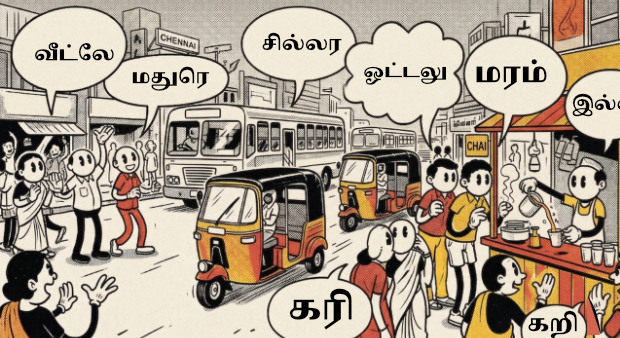
Why Spoken and Written Tamil Sound Different
So you've been studying Tamil. You've learned the script, you've practised your vowels, you've conjugated verbs until your brain hurts. And then you step outside in Chennai and… wait, what language are these people speaking?
Welcome to one of the most fascinating quirks of Tamil — a gap between the written and spoken language so wide that knowing one doesn't automatically help you with the other. This isn't unusual in the world (French and Arabic have similar situations), but in Tamil the divide is particularly striking.
The Bigger Picture: Diglossia in Tamil
Tamil is one of the world's oldest living languages, and like many languages with long literary traditions, it carries a significant gap between its written/formal register (centamil) and its everyday spoken form (kotuntamil). This formal/spoken divide is known linguistically as diglossia — and in Tamil, it is exceptionally sharp and consciously maintained.
- Formal Tamil appears in news broadcasts, literature, political speeches, religious texts, and formal writing.
- Spoken Tamil is used in films, casual conversation, comedy, and informal media.
- Neither is "wrong" — they are distinct registers of the same language, each with its own internal consistency and social function.
The shifts described below aren't errors or corruptions. They are the grammar of spoken Tamil — as systematic and learnable as any formal ruleset. Once you recognise the patterns, a huge portion of everyday Tamil conversation suddenly makes sense.
A. Vowel & Consonant Shifts
These are the most immediately noticeable changes — the sounds of Tamil words transform predictably and systematically in casual speech.
Initial Vowel Lowering
When a word begins with a high front vowel i or a high back vowel u, and the next syllable contains a low vowel a, spoken Tamil tends to lower that initial vowel. This is a natural phonetic process called vowel assimilation — the mouth anticipates the open vowel coming up and starts adjusting earlier.
| Written | Spoken | Meaning |
|---|---|---|
| Ilai | Ele | Leaf |
| Ungal | Onga | Your (plural/formal) |
In Ilai → Ele, the high i lowers toward e under the pull of the a in the second syllable. In Ungal → Onga, the u lowers to o, and the formal plural suffix -gal is also dropped entirely — a double transformation common in speech.
Final Vowel Changes
Word endings are a major site of divergence. Spoken Tamil consistently reshapes certain final vowel clusters into simpler, more fluid sounds.
-ai → -e: The diphthong -ai (two vowel sounds blended) is reduced to a simple -e vowel. This affects a huge number of Tamil nouns and adjectives:
| Written | Spoken | Meaning |
|---|---|---|
| Kadhai | Kadhe | Story |
| Illai | Ille | No / Not there |
-vugal → -nga: The formal plural suffix -vugal (or -gal) collapses into -nga in speech — shorter, softer, and far easier to integrate into rapid conversation. Notably, -nga does double duty: it functions both as a plural/respect marker and as a general politeness softener, even in singular contexts.
| Written | Spoken | Meaning |
|---|---|---|
| Sollungal | Sollunga | (Please) tell |
| Vaangal | Vaanga | (Please) come |
Consonant Cluster Simplification
Written Tamil preserves complex consonant clusters that are cumbersome in fast speech. Spoken Tamil smooths these out through assimilation — where one sound absorbs the features of a neighbouring sound.
-ndr- → -nn-: The cluster ndr involves three distinct articulatory movements. In speech, the d is absorbed into the surrounding nasals (progressive assimilation), producing a geminate (doubled) nn:
| Written | Spoken | Meaning |
|---|---|---|
| Ondru | Onnu | One |
| Andru | Annu | That day |
| Kundru | Kunnu | Hill |
-ttr- → -tt-: Similarly, the ttr cluster simplifies by dropping the r. The gemination of t preserves the "weight" of the original cluster while making it far easier to pronounce:
| Written | Spoken | Meaning |
|---|---|---|
| Katru | Kattu | Wind |
| Vitru | Vittu | Having left/sold |
B. Case Suffix Transformations
Tamil is a highly agglutinative language — grammatical relationships are expressed by stacking suffixes onto nouns. In formal writing, these suffixes are precise and standardised. In speech, they undergo consistent, rule-governed transformations.
| Grammatical Case | Written Suffix | Spoken Suffix | Written Example | Spoken Example | Meaning |
|---|---|---|---|---|---|
| Possessive | -udaiya | -oda | Ennudaiya | Ennoda | My |
| Locative (at/in) | -il | -le | Veettil | Veettle | In the house |
| Ablative (from) | -ilirundhu | -lerundhu | Oorilirundhu | Oorlerundhu | From town |
| Comitative – Human (with) | -idam | -kitte | Avanidam | Avankitte | With him |
A few things worth noting here. The possessive shift (-udaiya → -oda) is dramatic — a four-syllable suffix collapses to two, and this is one of the most consistent features across all spoken Tamil dialects. The comitative case shows an entirely different root in speech (-kitte vs. -idam), suggesting that in some cases these aren't just sound changes but different vocabulary choices that have become the spoken standard.
C. Verb Contractions
Verbs in spoken Tamil undergo some of the most dramatic compressions in the language. The present continuous tense is a particularly striking example.
-kondiru- → -kittu-
The formal present continuous is formed with the auxiliary kondu irukki- (literally "holding being"), signalling ongoing action. In speech, this collapses aggressively — what was a 6–7 syllable construction becomes 3–4 syllables without any loss of meaning to the listener:
| Written | Spoken | Meaning |
|---|---|---|
| Padithu-kondu-irukkiren | Padichittu-rukken | I am reading |
| Saapidu-kondu-irukkiren | Saapidttu-rukken | I am eating |
| Pesi-kondu-irukkiral | Pesittu-rukkaal | She is talking |
Dropping of Formal Respect Markers
Written Tamil marks formality and plurality in verb endings through suffixes like -gal, -ir, and -eer. In spoken Tamil, these are typically shortened or dropped, with respect conveyed instead through tone and intonation, the -nga softener added to requests and statements, and indirect phrasing understood from context. So where written Tamil would say Neenga Varuveergal (You [formal pl.] will come), spoken Tamil says simply Neenga Varuvenga — the social relationship is understood, not spelled out.
D. Vocabulary Substitutions
Beyond systematic sound changes, spoken Tamil also draws on an entirely different lexical layer — words that have evolved separately from the literary tradition, often with origins in older folk usage, regional variation, or natural phonetic drift over centuries. These aren't simply mispronunciations; in many cases both the formal and spoken words are ancient Tamil, but one thrived in the literary tradition while the other became the colloquial standard.
| English | Written Tamil (Formal) | Spoken Tamil (Colloquial) |
|---|---|---|
| Girl | Peṇ (பெண்) | Ponnu (பொண்ணு) |
| Five | Aindhu (ஐந்து) | Anju (அஞ்சு) |
| Mother | Thaai (தாய்) | Amma (அம்மா) |
| Water | Neer (நீர்) | Thanni (தண்ணி) |
| Now | Ippōthu (இப்போது) | Ippo (இப்போ) |
| House | Veedu (வீடு) | Veedla / Veedula (வீட்ல / வீடுல) |
Spoken Tamil is not “incorrect” or “slang.” It follows its own natural patterns. In everyday speech, words are often shortened, softened, or reshaped for ease and speed. For example, endings like -thu become -o (Ippōthu → Ippo), and additional sounds like -la are added to indicate location (Veedu → Veedla). These changes make spoken Tamil fluid and expressive, and they are widely used in daily conversation.
1. Dropped Sounds
Spoken Tamil is lazy in the best possible way. Why say six syllables when four will do? Sounds that are carefully written out get swallowed, clipped, or dropped entirely in real conversation.
The classic example is vowels that sit before ர் or ல். In writing they're right there on the page, but in speech they quietly disappear:
-
வீட்டிலே (in the house) becomes
வீட்லே. The middle syllable just… goes. -
கத்தரிக்காய் (brinjal) shrinks to
கத்ரிக்காய். Faster, right? -
சில்லறை (coins/change) gets clipped
to
சில்லரin everyday speech.
And then there's the opposite trick — adding a sound that isn't
written at all. Tamil really doesn't like words ending on a hard
consonant. So in speech, a supporting "u" gets tacked on to
smooth things out.
ஓட்டல் (hotel) becomes
ஓட்டலு. English loanwords get the same treatment —
bus becomes basu, cup becomes
kappu. Once you hear it, you'll notice it everywhere.
2. Two Letters, One Sound
Tamil script is ancient — it was designed to capture sounds that many modern speakers no longer distinguish in everyday speech.
The two r sounds. Written Tamil has
ர and ற,
which are technically different sounds. In many colloquial
dialects, when either appears between vowels, they end up
sounding identical. So
கரி (charcoal) and
கறி (curry/meat) —
spelled differently, but spoken the same in casual conversation.
Context usually saves you.
The three l sounds. This one trips up even
dedicated learners. Written Tamil clearly distinguishes
ல், ள்,
and ழ். In spoken Tamil, they blur.
The ழ் in
வாழைப்பழம் (banana)
might come out as ள், giving
வாளைப்பழம் — or in fast,
colloquial speech it can reduce further to
வாலப்பழம். In some strongly colloquial dialects it even
shifts toward a
y sound. The key point is: don't panic. Native speakers
navigate this effortlessly through context.
3. That Nasal Twang at the End of Words
Here's something no textbook really prepares you for. In casual Tamil speech, the endings of certain words pick up a soft nasal colouring — a kind of "ng" quality that bleeds into the final vowel sound.
It's not like French nasal vowels, where the nasalisation is
built into the phoneme. Think of it more as a feature of fast,
natural speech — the final ம் (m) of
a word softens and spreads its nasal quality into the syllable
before it. So
மரம் (tree) or
வரலாம் (may come) have
this gentle nasal quality at the end in natural speech that you
simply won't hear in formal recitation. It's subtle, but it's
one of those things that makes you sound like a real speaker
once you get it.
4. Reading the Destination Board vs. Asking a Local
If you've ever memorised a place name from a map and then completely failed to recognise it when someone said it out loud — this is why. Written Tamil preserves the ஐ (ai) ending on words and place names. Spoken Tamil quietly drops or softens it, and nobody warns you about this.
| Written | Spoken | Meaning |
|---|---|---|
| இல்லை (illai) | இல்ல (illa) | No |
| வேண்டாம் (vēṇṭām) | வேணாம் (vēṇām) | Don't want / No need |
| சென்னை (Cennai) | சென்ன (Cenna) | Chennai |
| மதுரை (Madurai) | மதுரெ (Madure) | Madurai |
| கோயம்புத்தூர் (Kōyamputtūr) | கோயம்புத்தூரு (Kōyamputūru) | Coimbatore |
So if you ask a local "எங்க போறீங்க?" and they say "சென்ன போறேன்" — yes, they mean Chennai. You've got this.
5. The Verb Gap: This Is the Big One
Okay, this is where things get really interesting for learners. The way verbs are formed in spoken Tamil is significantly different from what you'll find in any grammar book. Once you understand the patterns though, it clicks fast.
Present Tense: Where the "ki" Disappears
The formal present tense uses the marker -kkiṟ- (க்கிற). In speech, the middle "ki" simply vanishes, leaving a leaner -ṟ- connector.
| Written | Spoken | Meaning |
|---|---|---|
| பார்க்கிறேன் (pārkkirēn) | பாக்றேன் (pākṟēn) | I am seeing |
| செய்கிறேன் (seykiṟēn) | செய்றேன் (seyrēn) | I am doing |
| போகிறேன் (pōkkirēn) | போறேன் (pōṟēn) | I am going |
| சாப்பிடுகிறேன் (sāppiṭukiṟēn) | சாப்பிடுறேன் (sāppiṭuṟēn) | I am eating |
Spot the pattern? That -kkiṟ- becomes just -ṟ- every single time. Learn this one rule and a huge chunk of everyday Tamil conversation opens up.
Past Tense: Mostly Familiar, With One Exception
Good news — the past tense in spoken Tamil stays relatively close to the written form, especially when compared to the present tense. The changes are usually mild, with softer compression and fewer surprises.
| Written | Spoken | Meaning |
|---|---|---|
| பார்த்தேன் (pārttēn) | பாத்தேன் (pāttēn) | I saw |
| செய்தேன் (seytēn) | செஞ்சேன் (señcēn) | I did |
| போனேன் (pōnēn) | போனேன் (pōnēn) | I went |
| சாப்பிட்டேன் (sāppiṭṭēn) | சாப்பிட்டேன் (sāppiṭṭēn) | I ate |
The main exception is the verb செய் (sey – “to do”). Its past form doesn’t just shorten — the stem itself changes, from செய்த் (seyt-) to செஞ்ச் (señc-) in speech.
This kind of transformation happens with a small group of very common verbs, so it’s best to learn them individually rather than trying to apply a general rule.
Future Tense: The Stable One (Sort Of)
The future tense marker -v- (வ்) is largely stable across registers, with some minor consonant cluster simplification in speech. But here's the thing — in casual Tamil, people very often just use the present tense form to express future meaning anyway. "நான் நாளைக்கு போறேன்" literally means "I am going tomorrow" but functions perfectly as "I will go tomorrow." The formal future exists, but you won't always hear it.
| Written | Spoken | Meaning |
|---|---|---|
| பார்ப்பேன் (pārppēn) | பாப்பேன் (pāppēn) | I will see |
| செய்வேன் (seyvēn) | செய்வேன் (seyvēn) | I will do |
| போவேன் (pōvēn) | போவேன் (pōvēn) | I will go |
| சாப்பிடுவேன் (sāppiṭuvēn) | சாப்பிடுவேன் (sāppiṭuvēn) | I will eat |
Saying No: The -māṭṭēn Construction
Tamil has multiple ways to express negation in writing, including both -āt- and -māṭṭ- forms. In everyday speech though, -māṭṭēn dominates so completely that using the formal -āt- construction out loud would sound stiff and unusual to most ears.
| Written | Spoken | Meaning |
|---|---|---|
| பார்க்கமாட்டேன் (pārkkamāṭṭēn) | பாக்கமாட்டேன் (pākkamāṭṭēn) | I will not see |
| செய்யமாட்டேன் (seyyamāṭṭēn) | செய்யமாட்டேன் (seyyamāṭṭēn) | I will not do |
| போகமாட்டேன் (pōkamāṭṭēn) | போகமாட்டேன் (pōkamāṭṭēn) | I will not go |
| சாப்பிடமாட்டேன் (sāppiṭamāṭṭēn) | சாப்பிடமாட்டேன் (sāppiṭamāṭṭēn) | I will not eat |
The rule: The -māṭ- negative is so dominant in spoken Tamil that the formal -āt- construction sounds unnatural in everyday conversation. If you use the written form aloud, native speakers will understand you — but you will sound like a textbook.
Don't Mix These Up
Quick note before we move on —
பாரும் (pārum) is
not a polite command. It's a future tense form,
and mixing it up is a common mistake. Here's how commands
actually work:
| Written | Spoken | Meaning |
|---|---|---|
| பார் (pār) | பாரு (pāru) | Look / See (casual) |
| பாருங்கள் (pāruṅkaḷ) | பாருங்க (pāruṅka) | Look / See (polite) |
| போ (pō) | போ (pō) | Go (casual) |
| போங்கள் (pōṅkaḷ) | போங்க (pōṅka) | Go (polite) |
The pattern is simple: the polite suffix -uṅkaḷ drops its final -ḷ in speech to become -uṅka. Once you know this, polite commands in conversation become second nature.
The Writer's Workaround (எழுத்தாளரின் தீர்வு)
Here’s a fun problem: if you’re writing a comic strip, a play, or a novel—and your characters speak the way real people speak—how do you write their dialogue?
You can’t write it fully phonetically, because many readers would struggle to follow it. But if you write it in formal Tamil, your characters sound stiff, almost like they’re reading from an inscription.
The solution Tamil writers have arrived at is a clever compromise. They often write
உட்கார்ந்தாரு (uṭkārntāru), preserving familiar
letter forms, instead of the fully phonetic
உக்காந்தாரு (ukkāntāru), which may be harder to read
at first glance.
They also tend to retain distinctions like ர் and ற், even in colloquial dialogue, because removing them can make words harder to recognize or change their meaning.
The result is a kind of literary colloquial Tamil—not exactly how people speak, and not strictly formal either, but a natural middle ground that most readers intuitively understand. It’s an elegant solution to the gap between spoken and written language.
Transliteration note: ā = long a, ṭ = retroflex t, ṟ = the second r sound, ẓ = the ழ் sound, ḷ = retroflex l.