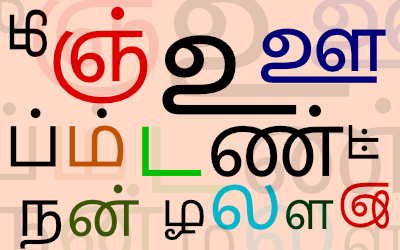
Confused by Similar-Looking Tamil Letters? Here's a Friendly Guide for Absolute Beginners
Learning Tamil is a truly rewarding experience. With its deep cultural roots, poetic rhythm, and one-of-a-kind script, it's a language that draws you in. But let's be honest — if you're just starting out, there's a good chance you've found yourself squinting at the letters, thinking, “Wait… didn't I just see this one?”
Many Tamil learners hit the same bump early on: some of the letters look surprisingly similar. At first glance, it's easy to feel like you're seeing double. But don't worry — this is totally normal, and there are simple ways to make sense of it all..
Why Tamil Letters Can Look Similar
Tamil is one of the oldest living languages in the world, with its own elegant and distinctive script. It includes 12 vowels (உயிரெழுத்துகள்), 18 consonants (மெய்யெழுத்துகள்), and 216 compound letters (உயிர்மெய்யெழுத்துகள்) formed by combining vowels and consonants. That brings the total to 246 core letters. In addition, Tamil has one special character called ஃ (ஆய்தம்), which is not a vowel or consonant but is traditionally included in the alphabet. With this, the full count comes to 247 letters in the Tamil script.
What makes Tamil so unique can also pose a small challenge for beginners: many letters are formed with rounded strokes and subtle curls. This means some of them can look almost identical — especially if you're used to the Latin alphabet.
Commonly Confused Tamil Letters
Let's break it down, category by category, with some memory tips to help you out.
1. க் (ka) vs ஞ் (ña)
At first glance, both letters are short and curve downward. The key difference is in the complexity of the curve.
- க் (ka) looks like a simple “c” shape with a horizontal line through it.
- ஞ் (ña) has a more complex, tight curl at the bottom right.
Memory Tip: Think of ஞ் as a tight noodle twist, while க் is like an open hook.
2. ப் (pa) vs ம் (ma)
Both letters are round at the top and short in height, which makes them easy to mix up.
- ப் (pa) is more open at the base, like a small, wide cup.
- ம் (ma) has a tiny, distinct curl on the left-bottom corner.
Memory Tip: The curl in ம் (ma) looks like a tiny mustache. Think "m for mustache"!
3. ந் (na) vs ன் (ṉa)
These represent two different "n" sounds and their shapes are notoriously similar. The difference is very subtle.
- ந் (na) is the dental 'n' (like in "month").
- ன் (ṉa) is the alveolar 'n' (like in "sun").
Memory Tip: This is one of the hardest pairs. At first, rely on the context of the word you're reading. Over time, your brain will start to see the subtle difference in the final stroke.
4. ட் (ṭa) vs ண் (ṇa)
Both letters have a horizontal top line, but the bottom part is different.
- ட் (ṭa) is shaped like a flat bench or a table with two legs.
- ண் (ṇa) has a small hook or flick that comes up from the bottom line.
Memory Tip: The sound ண் (ṇa) is heavier and more retroflex. Think of the hook as adding "weight" to the letter's shape.
5. The "L Triplets": ழ் (ḻa) vs ல் (la) vs ள் (ḷa)
These three are a huge challenge for beginners. Mastering them is a big step towards sounding authentic.
- ழ் (ḻa): This is a unique sound often described as 'zha'. The letter has a twisty, looped shape—a double bend that makes it stand out. It's the most complex of the three.
- ல் (la): This is the regular "l" sound. The letter has a clean, simple downward stroke.
- ள் (ḷa): This is a retroflex 'L' sound. The letter looks like ல் but with a curved hook in the middle, almost like a small question mark.
Memory Tip: Link the shape to the sound: ழ் is twisty, ல் is simple, and ள் has a hook.
6. Vowels: இ (i) vs ஈ (ii)
These are the short and long "i" sounds.
- இ (i) is short and compact.
- ஈ (ii) has a longer, more pronounced curve on top.
Memory Tip: Longer sound = longer stroke!
7. Vowels: உ (u) vs ஊ (uu)
The short and long "u" sounds also have a simple distinction.
- உ (u) is a simple, rounded shape.
- ஊ (uu) has a little upward tail or curl at the top right, which உ lacks.
Memory Tip: That upward tail is like stretching the sound out to make it longer.
Telling Similar Letters Apart
Even after you've noticed the visual differences, your brain needs a bit of practice to truly lock in the patterns. Here are a few things you can try to make those tricky letters stick:
- Practice Writing Pairs: Take a lined notebook and write each similar pair side-by-side (e.g., ப் - ம், ப் - ம்). This builds muscle memory and trains your eyes.
- Look for “Hooks,” “Tails,” and “Loops”: When a letter confuses you, actively ask: Is there a loop at the bottom? Is the tail going up or down? Is it open or closed?
- Use Mnemonics and Images: Make silly associations that stick. "ம் has a mustache." "ழ் has a twist like a corkscrew."
- Read Real Tamil Words: Start with children's books or simple signs. Seeing letters in real context helps you remember how they function and appear.
- Listen While You Read: Use language learning apps or watch YouTube videos with Tamil alphabet songs. Connecting the sound to the symbol is crucial.
It's Totally Normal
Everyone — yes, you read that right — struggles with these letters at first. Even native Tamil-speaking children learn them slowly and steadily, so it's completely normal to take your time. The Tamil script is deeply logical.